
C-BE20 Dual Station Level Alarm
An intelligent level alarm unit, able to independently monitor liquids to either high or low levels. Can be used for monitoring bilge, compartment areas or holding tanks etc.
Description and Operation
The unit can be used to monitor tank or compartment levels via 2 independently controlled sensor / trigger devices to either display a high level (fluid at maximum height) or low level. The sensors are pulsed every 20 seconds to conserve battery life and have built in delays of 3 seconds to prevent the unit being constantly triggered by the sloshing of liquids. The unit can be used with either 1 or 2 sensors being fitted and either sensor input can be used to monitor high or low levels. When triggered the unit will sound an alarm and an LED will light to show which sensor has caused the alarm. Pressing the silence button will stop the alarm but the LED will continue to be lit until the level has been corrected. The alarm will automatically silence within 30 seconds to conserve battery power.
Installation
The control unit must be mounted away from sources of excessive heat and moisture and not adjacent to any magnetic compasses. It is recommended that suitable crimps are fitted to all bared conductor ends to ensure a safe reliable contact within the terminal blocks. Connect the unit up as per the circuit shown below. An inline switch is not required unless the user would like to completely isolate the unit from the supply, as the front panel switches turn the unit on and off. If an inline fuse is fitted it should be a 1amp rating, though the unit is fitted with internal surge protection. Refer to the manufacturers operating instructions for the sensors / switches being used, the supplied diagram shows the 4 wire optic sensors connected. Ensure that all cables are carefully run and clipped into position. Avoid running cables in areas where they will be continually immersed in liquid or will be prone to abrasion.
Rear View of Unit
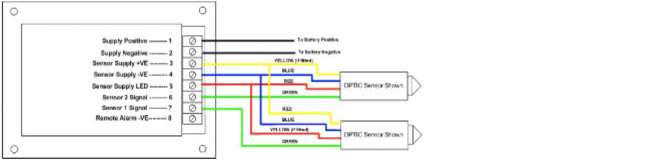
Testing The System
Carefully check the wiring to ensure correct connection. If the sensors are not fitted with a tank at this stage, testing will be easier.
High Level Test:- Switch sensor 1 to HIGH level, the power on lamp will light. Immerse the sensor into water and within 30 seconds the alarm will sound and the LEVEL lamp will light. Press the silence button and the alarm will stop, but the light will stay illuminated. Remove the senor from the liquid (ensuring that there isn't a bead left hanging over the lens) and after a few seconds the lamp will extinguish.
Low Level Test:- Place the sensor in a liquid and switch the unit to LOW level, the power on lamp will light. Remove the sensor from the liquid (ensuring that there isn't a bead left hanging over the lens) and within a few seconds the alarm will sound and the LEVEL lamp will light. Press the silence button to stop the alarm, the lamp will stay lit. Immerse the sensor back into the liquid and after a few seconds the lamp will extinguish. Repeat the above tests for the second sensor.
Remote Alarm
If a remote alarm is required it is recommended that a solid state type operating on 12V DC is used. Simply connect the POSITIVE wire of the alarm to the positive supply and the NEGATIVE wire to terminal 8 on the Dual Station Alarm. The Alarm unit must not exceed 200mA and should ideally have its own fuse of a suitable rating. The silence button on the panel will operate both the internal and the remote alarm.
Float Switches
If float switches or any form of sensor with simple switch contacts are to be used, connect one side of the switch to 0V or battery Negative and the other side to the sensor signal input terminal. Closing the contacts while set to HIGH level will trigger the unit, while opening the contacts will trigger it if set in the LOW level mode.
- Specification:
- 12 or 24V DC supply. Reverse polarity and transient voltage protected.
- Very low current consumption; pulsed sensor outputs reduce current use.
- Independent inputs can be set for either "High" or "Low" level fluid monitoring.
- Compatible with almost ANY sensor including bilge float switches. A sensor is available for monitoring of liquids other than water such as petrol or oil.
- System is not affected by splashes or slosh.
- Rugged solid state design.
- Panel mounting (bulkhead version can be supplied)
- Easy installation; simple terminal block connections.
- Additional Remote sounder available.
- Buzzer silence facility